In his book Reflections on Relativity (2010), Kevin Brown talks about the light speed principle in special relativity in great detail. He makes careful distinctions between what is empirical fact and what is conventional or a matter of decision-making. He acknowledges that different choices are possible and that there are and always have been debates among physicists on which of these are preferable. And he engages with those debates.
All of this makes his book a pleasure to read for somebody who has long felt that there is much more to relativity than what most textbooks tell their readers. Somebody who, as a student, despaired of an approach to the teaching of physics which allowed no room for debate or questions. Somebody who, years later, by writing this blog, is trying to gain a deeper understanding of special relativity than he could ever have hoped to gain as an undergraduate.
And there is more. Kevin Brown, with his knowledge of the historical background, his awareness of conceptual issues and his grasp of technical details, clearly comes down on the side of Newton and Einstein on the issue of simultaneity, and thus on the side of Einstein's light speed principle. Which makes his writings an ideal test for a sceptic like myself.
Brown makes it clear early on in his book that there is a choice regarding time coordinates. He says one possibility is to choose them so that inertia is isotropic, in other words "the force required to accelerate an object from rest to a given speed is the same in all directions". This "effectively establishes the planes of simultaneity of inertial coordinate systems".
Brown's main argument in favour of time coordinates which ensure inertial isotropy is that they lead to "the usual symmetrical laws of mechanics" and are therefore "the most intuitive, convenient, and readily accessible systems" (pp. 24-27).
Elaborating on these ideas, he approvingly quotes Henri Poincaré as saying in 1898 that we naturally choose our coordinate systems "in such a way that the statements of the natural laws are as simple as possible", and according to Brown that "almost invariably means inertial coordinates". "We simply choose, of our own free will, to use inertial coordinates - with the corresponding inertial definition of simultaneity - because this renders the statement of physical laws and the descriptions of physical phenomena as simple and perspicuous as possible, by taking advantage of the maximum possible symmetry," Brown insists. The constancy of the speed of light in terms of such coordinates is then "an empirical fact" (pp. 290-291).
Brown acknowledges, however, that "it could be argued that a total unique temporal ordering of events is a more useful organizing principle than the isotropy of inertia". This is true "especially if we regard the total temporal ordering of events as a requirement of intelligibility". But, Brown goes on, that approach "suffers from a certain inherent lack of conviction, because while asserting the ontological reality of anisotropy in all but one (unknown) frame of reference, it unavoidably requires us to disregard that assertion and arbitrarily assume one particular frame as being 'the' rest frame" (pp. 292-293).
Brown's account adds up to a very detailed, clear and persuasive argument for choosing time coordinates in accordance with Einstein's or Newton's clock adjustment procedures, which turn out to be equivalent.
But there is a question which Brown does not address directly. Like all the other authors discussed in this blog, Brown says events with equal time coordinates as measured by Einstein- or Newton-adjusted clocks are "simultaneous" without exploring or explaining why that should be the case. However, unlike any of the authors discussed before, Brown drops a number of hints suggesting that there may in fact be a problem with "simultaneity" in special relativity.
One of these hints is his acknowledgment that choosing time coordinates in accordance with Einstein's or Newton's clock adjustment procedure may lead to a problem of "intelligibility". Sadly, Brown does not explore what this problem consists in and how it comes about.
My own view is, of course, that Einstein's and Newton's clock adjustment procedures - for all their benefits in terms of simplicity and symmetry - lead to a situation in which equal time coordinates do not invariably imply a relationship of simultaneity. And that this fact renders the resulting theory unintelligible unless it is made explicit and its repercussions on the applicability of concepts that rely on the concept of simultaneity are explored and explained.
Brown indirectly addresses some of these repercussions in a chapter on "The Breakdown of Simultaneity". He points out that, if Einstein's or Newton's clock adjustment procedure are used, an accelerated observer may find that one and the same distant event "is assigned multiple times of occurrence" (p. 313). I'd suggest that this would only pose a problem if we took the meaning of "simultaneity" in relativity seriously, because we'd then have to conclude that for such an observer certain events do not just appear to occur but really do occur several times over, which is nonsense. The problem resolves itself if we realise that, in general, equal time coordinates in relativity do not imply a relationship of simultaneity in the first place.
Another hint in Brown's book that the concept of simultaneity in relativity may be flawed is his acknowledgment that Einstein's clock adjustment procedure relies on the assumption of "memorylessness", in other words the idea that an elementary particle does not "somehow 'remember' its entire history of accelerations and thereby 'know' its present absolute velocity relative to a common fixed reference" (p. 53). The potential importance of a particle's acceleration history is of course something I have emphasized in previous blog posts (for example here), although I have not used expressions such as "memory" or "remembering".
Again, sadly, Brown does not develop this point beyond mentioning that "Weyl's unified field theory" was apparently built on the premise that particles can remember their acceleration history. Unfortunately I have not been able to find any documentation on that theory to see how it relates to my own ideas.
The possibility that a particle's acceleration history may determine whether or not light emitted by that particle propagates in symmetrical conditions in all directions is also relevant to Brown's assertion that a total temporal ordering would require us to "arbitrarily" choose one frame of reference in which light is deemed to propagate isotropically. If the assumption of "memorylessness" were wrong and if we knew something about the acceleration history of a system of particles we want to study, then perhaps our choice of reference frame in which light is deemed to propagate in symmetrical conditions would not have to be entirely arbitrary. And we might find that there is not just one but many frames of reference in which light locally propagates in symmetrical or at least broadly symmetrical conditions.
Brown's book thus contains a number of pointers regarding the issue of convention in the light speed principle which I intend to follow up in this blog over the years and decades to come.
Before I conclude this post, I would like to mention another book which I have come across recently and which is just as clear as Brown's on the element of convention in the light speed principle, but which has similar limitations regarding the meaning of "simultaneity" in relativity.
This is the textbook "Special Relativity - A new way into Einstein's world" by Helmut Günther (2007). The author says he wants to break with traditional introductions to special relativity which "start by confronting unsuspecting readers with the incredible postulate of the universal constancy of the speed of light - Einstein's principle of relativity - and then leave them to lose themselves in endless musings about the no less incredible consequences concerning the behaviour of moving measuring rods and clocks" (p. 7).
An excellent plan!
Günther proceeds to give due prominence to the role of clock adjustment procedures in the light speed principle and shows how the Lorentz transformations and Einstein's whole theory can be derived very simply by:
a) adjusting clocks in a first frame of reference Σ using Einstein's clock adjustment procedure;
b) requiring clocks in any other frame of reference S moving at v relative to Σ to be adjusted such that Σ is measured to be moving at -v from the point of view of S - Günther calls this the "elementary principle of relativity";
c) finding empirically that the time dilation and length contraction factors in Σ have the values they have in special relativity (pp. 36-60).
All that is very clear and very interesting.
But an important pillar of the whole edifice crumbles in a single sentence on page 36, where Günther asserts that "in principle" we are "free to agree how to synchronize clocks" in the S frames. He adds that we are in fact well-advised to follow Henri Poincaré in choosing a procedure which makes the transformation formulas particularly simple and symmetrical, and that it is therefore sensible to apply b) above.
We are "free to agree how to synchronize clocks"? Really? So, if we agree to "synchronize" two clocks at opposite ends of a table by setting one to 1 o'clock and the other to 2 o'clock, then we have in fact synchronized them? That's plain nonsense because, at the risk of repeating myself, not every clock adjustment procedure is a synchronization procedure! And there is no reason to believe - and Günther does not even try to make that case - that the clock adjustment procedure implicit in b) above actually synchronizes clocks in the S frames.
So, Günther, for all his best intentions, ends up still confronting unsuspecting readers with a rather incredible claim, namely that his "elementary principle of relativity" has anything to do with synchronizing clocks!
And that concludes my review of the literature on the role of convention in the light speed principle.
Of course, if any of my readers think that there are important publications on the issue which I have failed to mention, I'd love to hear about them.
In the meantime, I'd recommend the following to anybody trying to gain a proper understanding of the special theory of relativity:
READ Albert Einstein, read Reza Mansouri/ Roman U. Sexl, read Kevin Brown and read Helmut Günther. Pay particular attention to their explanation of the role of convention in the light speed principle, because convention plays an important role in that principle and all the above-mentioned authors are very clear about that.
BUT replace every mention of "synchronization" in those publications with "clock adjustment", every mention of "simultaneous events" with "events with equal time coordinates" and every mention of "speed" with "coordinate speed using clocks which are not necessarily synchronized".
AND do not fall into the trap of the simultaneity syndrome, in other words be aware that any concepts that rely on synchronization, such as one-way speed, causality and simultaneous existence, have at best limited applicability in special relativity.
THEN you should be well-placed to begin to make sense of it all.
A fuller summary of my findings to date, and a glimpse of which questions I am going to address next, will have to wait until my next post.
Saturday, 23 June 2012

Saturday, 5 May 2012
Newton's idea of simultaneity
If, as Kevin Brown says in his book on relativity, Einstein's clock adjustment procedure using light signals leads to the same clock adjustment as Newton's clock adjustment procedure using objects, it is worth investigating whether or not Newton's procedure is a synchronization procedure, in other words whether or not it ensures that events with equal time coordinates are simultaneous.
From a purely logical point of view, it is clear that in general Newton's procedure cannot be a synchronization procedure because I have already shown, here and in subsequent posts, that in general Einstein's procedure is not a synchronization procedure.
But it would be nice to be able to see that directly, by examining Newton's procedure more closely.
In Newton's procedure - or more precisely the procedure which is implicit in his laws of mechanics - two clocks A and B in a first spatial inertial system S1 are adjusted to show the same time when identical objects projected in opposite directions from the mid-point between A and B using identical acceleration mechanisms arrive at those clocks, provided the conditions in which the objects are accelerated and in which they travel are symmetrical in both directions. Events with equal time coordinates in S1 are then simultaneous by virtue of the very meaning of simultaneity.
The crucial question is how we can then adjust clocks in a second spatial inertial system S2 that moves relative to the first. According to Newton, we can do that by accelerating the clocks, the objects and the accelerating mechanisms used in S1 so that they come to rest in S2 and performing the same procedure in S2 to adjust distant clocks in that system.
Let's assume that in both frames the procedure is performed in "empty space", notably in the absence of any medium such as air which might disturb the symmetry of the conditions in which the objects are accelerated or travel.
But even in the absence of any medium such as air, after the clocks, the acceleration mechanisms and the objects have been accelerated in one particular direction, are the conditions in which the procedure is then performed in S2 still symmetrical in opposite directions?
Newton evidently thought they were. And it's easy to see why. Newton didn't know that "empty space" is in fact filled with all manner of fields which surround any object. To him, the objects used in S2 would be just the same objects as they were in S1 and the symmetry of the conditions of any further acceleration and movement in opposite directions would not have been disturbed by their acceleration from S1.
That is why he thought that, as measured by Newton-adjusted clocks in S1, two identical objects at rest in S2 would undergo the same acceleration if they were projected in opposite directions using identical acceleration mechanisms. Today we know that this is not the case.
And that does not come as a surprise given that today we know that all objects are surrounded by, for example, electromagnetic fields. We also know that disturbances in such fields need some time to travel over any closed path.
Let's take the example of a simple electron whose field is spherically symmetrical in S1 and let's see how that field is affected if the electron is accelerated locally, for example as the result of a collision.
Qualitatively, and without adjusting any clocks, any field disturbance can be expected to propagate symmetrically around the electron's original position of rest, but the movement of the electron in one particular direction then creates asymmetrical conditions in the field surrounding it.
Quantitatively, let's assume that at a time t1 in S1 an electron at rest in S1 and surrounded by a spherically symmetrical field undergoes such a sudden acceleration to a speed v.

The field is represented here by a series of concentric spheres surrounding the electron. At the time t2 > t1 in S1, the electron moves at v and information about its acceleration is spreading outwards through the electron's field. Each of the spheres surrounding the electron starts to move at v when the information about the acceleration reaches it, leading to the following situation at the time t2:

As the information spreads further, the area around the electron in which the sphere density is asymmetrical grows:

At the boundary between areas of different density, shown in red, an electromagnetic signal propagates away from the electron (for details on how this happens, see Lesson 4 in this document by Daniel V. Schroeder). Any further sudden acceleration of the electron would give rise to a new electromagnetic signal. And the light speed law appears to be that any acceleration information always traverses the same number of spheres in the same amount of time. This means that locally in S1 the speed of an electromagnetic wave is independent of the speed of the light-emitting body.
The sphere model illustrates the fact that if the field around an electron, and thus around any object containing electrons, is symmetrical, then the field around the same electron accelerated locally to a speed v is no longer symmetrical. And for that reason Newton's clock adjustment procedure applied in a second frame S2 moving at a speed v relative to S1 is not a synchronization procedure.
At least not locally. Over cosmic distances, Newton's or Einstein's procedure may well be applicable to sets of clocks that move at a speed v relative to one another. The reason for that is that clocks that are very distant from each other may be moving relative to each other as a result of certain kinds of acceleration which disturb the local fields around them only negligibly. As far as I understand it, cosmic expansion and gravity are examples of such locally non-perturbative accelerations:
 Locally, however, all particles or objects are subjected to the same gravitational or cosmic expansion influences. Therefore, if they move relative to each other locally then that must be the result of previous local accelerations which have disturbed the electric fields surrounding them.
My investigation into whether or not Newton's clock adjustment procedure is a synchronization procedure has led me to develop my sphere model of electricity and light propagation a bit further in this post.
After these flights of fancy, it is time to test my thoughts against the best of the literature on simultaneity in Newton's and Einstein's theories. And that leads me straight back to Kevin Brown's book Reflections on Relativity. In my next post.
From a purely logical point of view, it is clear that in general Newton's procedure cannot be a synchronization procedure because I have already shown, here and in subsequent posts, that in general Einstein's procedure is not a synchronization procedure.
But it would be nice to be able to see that directly, by examining Newton's procedure more closely.
In Newton's procedure - or more precisely the procedure which is implicit in his laws of mechanics - two clocks A and B in a first spatial inertial system S1 are adjusted to show the same time when identical objects projected in opposite directions from the mid-point between A and B using identical acceleration mechanisms arrive at those clocks, provided the conditions in which the objects are accelerated and in which they travel are symmetrical in both directions. Events with equal time coordinates in S1 are then simultaneous by virtue of the very meaning of simultaneity.
The crucial question is how we can then adjust clocks in a second spatial inertial system S2 that moves relative to the first. According to Newton, we can do that by accelerating the clocks, the objects and the accelerating mechanisms used in S1 so that they come to rest in S2 and performing the same procedure in S2 to adjust distant clocks in that system.
Let's assume that in both frames the procedure is performed in "empty space", notably in the absence of any medium such as air which might disturb the symmetry of the conditions in which the objects are accelerated or travel.
But even in the absence of any medium such as air, after the clocks, the acceleration mechanisms and the objects have been accelerated in one particular direction, are the conditions in which the procedure is then performed in S2 still symmetrical in opposite directions?
Newton evidently thought they were. And it's easy to see why. Newton didn't know that "empty space" is in fact filled with all manner of fields which surround any object. To him, the objects used in S2 would be just the same objects as they were in S1 and the symmetry of the conditions of any further acceleration and movement in opposite directions would not have been disturbed by their acceleration from S1.
That is why he thought that, as measured by Newton-adjusted clocks in S1, two identical objects at rest in S2 would undergo the same acceleration if they were projected in opposite directions using identical acceleration mechanisms. Today we know that this is not the case.
And that does not come as a surprise given that today we know that all objects are surrounded by, for example, electromagnetic fields. We also know that disturbances in such fields need some time to travel over any closed path.
Let's take the example of a simple electron whose field is spherically symmetrical in S1 and let's see how that field is affected if the electron is accelerated locally, for example as the result of a collision.
Qualitatively, and without adjusting any clocks, any field disturbance can be expected to propagate symmetrically around the electron's original position of rest, but the movement of the electron in one particular direction then creates asymmetrical conditions in the field surrounding it.
Quantitatively, let's assume that at a time t1 in S1 an electron at rest in S1 and surrounded by a spherically symmetrical field undergoes such a sudden acceleration to a speed v.

The field is represented here by a series of concentric spheres surrounding the electron. At the time t2 > t1 in S1, the electron moves at v and information about its acceleration is spreading outwards through the electron's field. Each of the spheres surrounding the electron starts to move at v when the information about the acceleration reaches it, leading to the following situation at the time t2:

As the information spreads further, the area around the electron in which the sphere density is asymmetrical grows:

At the boundary between areas of different density, shown in red, an electromagnetic signal propagates away from the electron (for details on how this happens, see Lesson 4 in this document by Daniel V. Schroeder). Any further sudden acceleration of the electron would give rise to a new electromagnetic signal. And the light speed law appears to be that any acceleration information always traverses the same number of spheres in the same amount of time. This means that locally in S1 the speed of an electromagnetic wave is independent of the speed of the light-emitting body.
The sphere model illustrates the fact that if the field around an electron, and thus around any object containing electrons, is symmetrical, then the field around the same electron accelerated locally to a speed v is no longer symmetrical. And for that reason Newton's clock adjustment procedure applied in a second frame S2 moving at a speed v relative to S1 is not a synchronization procedure.
At least not locally. Over cosmic distances, Newton's or Einstein's procedure may well be applicable to sets of clocks that move at a speed v relative to one another. The reason for that is that clocks that are very distant from each other may be moving relative to each other as a result of certain kinds of acceleration which disturb the local fields around them only negligibly. As far as I understand it, cosmic expansion and gravity are examples of such locally non-perturbative accelerations:

My investigation into whether or not Newton's clock adjustment procedure is a synchronization procedure has led me to develop my sphere model of electricity and light propagation a bit further in this post.
After these flights of fancy, it is time to test my thoughts against the best of the literature on simultaneity in Newton's and Einstein's theories. And that leads me straight back to Kevin Brown's book Reflections on Relativity. In my next post.
Sunday, 4 March 2012
Brown's "inertial coordinate systems"
In his 1905 article "On the Electrodynamics of Moving Bodies", Einstein explained how clocks can be adjusted "in a coordinate system in which Newton's equations of mechanics hold" (p. 892).
There is a problem with this formulation since, if we have not already adjusted any distant clocks in a given frame of reference, we have no way of knowing whether or not Newton's laws hold in that frame, not to mention the fact that in special relativity Newton's laws do not precisely hold anyway.
So, what kind of coordinate system was Einstein really trying to identify? The answer given by Kevin Brown in his book Reflections on Relativity (2010) is that he was trying to identify "inertial coordinate systems", defined by Brown as systems "in terms of which inertia is homogeneous and isotropic, so that free objects move at constant speed in straight lines, and the force required to accelerate an object from rest to a given speed is the same in all directions" (p. 27).
This quote requires some unpicking.
First, what is "inertia"? According to Brown, the "principle of inertia" is the idea that "in the complete absence of external forces, an object would move uniformly in a straight line, and that, therefore, whenever we observe an object whose speed or direction of motion is changing, we can infer that an external force... is acting upon that object". Brown says this principle was first formulated in the 17th century and represents "the most successful principle ever proposed for organizing our knowledge of the natural world" (p. 22).
Of course, Brown's explanation of the principle of inertia introduces some new concepts that may be deemed to be in need of explanation, such as "uniform motion", "straight line" and "force". However, it seems to me that these can in turn be explained without resorting to any laws of mechanics and even without first adjusting distant clocks: "straight lines" can be equated with lines of sight in the absence of very massive bodies, such as stars; "uniform motion" can be established using signals emitted at regular intervals from a moving body; and instead of "in the absence of external forces" we could say "in the absence of specific sets of conditions, such as collisions, known to stop objects from moving uniformly and in straight lines".
So, a "spatial inertial coordinate system" could be defined as a series of markers which are arranged in straight lines at regular spatial intervals, established for example by means of standard rods, and relative to which objects that are not subjected to any force move uniformly in straight lines.
What is missing from this definition is time coordinates or, what amounts to the same thing, a procedure to adjust clocks in distant points.
As Brown points out, such a procedure to adjust distant clocks is implicit in Newton's "laws" of mechanics, which thus turn out to be not pure laws of nature but in part the result of a particular clock adjustment choice.
This choice was to use identical mechanisms to propel identical objects in opposite directions from the mid-point between two clocks at rest in a spatial inertial coordinate system and to set those clocks to the same time when the objects arrive there.
Once this has been done, the "speed" of such an object propelled by such a mechanism can be measured using those two clocks and the distance between them. Knowledge of that speed can then be used, together with knowledge of the distances between other clocks, to adjust any other clocks at rest in the same spatial inertial coordinate system and thus to establish a full inertial coordinate system. It is found empirically that the time coordinates in such a coordinate system do not depend on the kind of object or acceleration mechanism used to adjust distant clocks.
It is then clear that in such a coordinate system inertia is "isotropic", in other words if identical objects at rest in the system are accelerated by the same kind of mechanism in different directions, they reach the same speed. This is guaranteed by the way we have adjusted our clocks. And this clock adjustment convention, or choice, or decision, was written into Newton's second "law", which states that the "change of motion is proportional to the motive force impressed, and is made in the direction of the right line in which that force is impressed" (quoted in Brown, p. 23).
Newton's clock adjustment procedure may well seem perfectly plausible even to a modern mind: if we use identical mechanisms to propel identical objects in opposite directions along paths of equal length, then we may surely assume that they arrive at the end of those paths at the same time, by virtue of the very notion of simultaneity. So it seems that we are entitled to adjust clocks using Newton's procedure. Indeed, it would appear that we are obliged to do so if we want to synchronize our clocks, in other words if we want equal time coordinates to express a relationship of simultaneity.
But then Brown says on page 32 that Newton's procedure is empirically found to lead to the same clock adjustment as Einstein's light signal procedure, and I have previously stated that in general Einstein's procedure is not a synchronization procedure. Was I wrong? My next post will tell.
Monday, 6 February 2012
The "deeper reason" for the twin paradox
In their article on "A Test Theory of Special Relativity: I. Simultaneity and Clock Synchronization" (1977), Reza Mansouri and Roman U. Sexl raise the question of whether there are any meaningful alternatives to applying Einstein's clock adjustment procedure in every uniformly moving frame of reference. In particular, they consider whether there might be a preferred "ether" frame in which it would be sensible to apply Einstein's procedure while all clocks in every other frame would be adjusted based on clock readings in the preferred frame.
The authors begin by suggesting that the cosmic background radiation defines a system of reference which is a candidate for a possible "ether frame", but they do not explain how or why that might be the case.
Later in the article, the authors refer to a frame Σ in which Einstein's clock adjustment procedure and the slow transport clock adjustment procedure agree as an "ether frame". In the slow transport procedure, clocks in different locations are adjusted to the time shown by a single clock that is "slowly" moved to those locations. The slowness of the clock has to be established either by an existing set of clocks that have already been adjusted somehow, or by using the clock's "self-measured" speed: the distance it has traversed divided by the time that has passed as shown by the clock itself.
Once again it is not clear in what sense such a reference frame would constitute an "ether frame" if by "ether frame" the authors mean a frame in which Einstein-adjusted clocks are synchronized.
What is more, any suggestion that slow clock transport provides an independent way of adjusting distant clocks is somewhat undermined later in the article when the authors show that slow transport clock adjustment is equivalent to Einstein clock adjustment if and only if the empirically determined time dilation factor in Σ is given by its relativistic value. A slightly modified version of their proof can be found here.
In a nutshell, Mansouri and Sexl end up without any method of identifying a "preferred" system of reference in which we can be sure that Einstein-adjusted clocks have been synchronized at least locally.
They nevertheless consider what happens if we arbitrarily choose a frame Σ in which clocks are Einstein-adjusted and then adjust clocks in all other uniformly moving frames by comparing them with clocks in Σ, a procedure the authors call "external synchronization".
Specifically, they consider in some detail what happens if we adjust clocks in all other frames by setting them to zero when they pass a clock in Σ which shows zero:
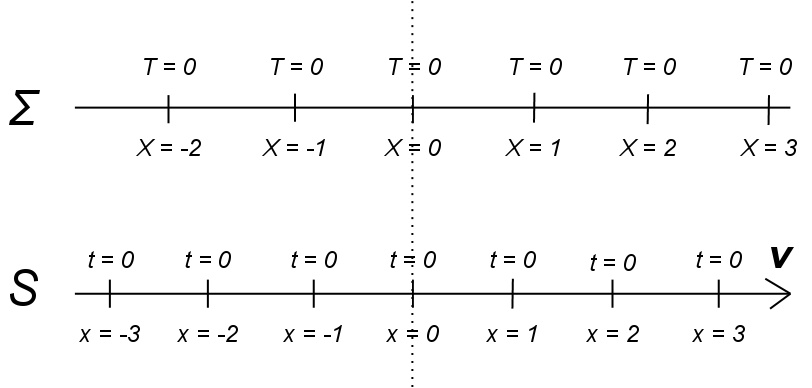
In this diagram, the time in Σ is T = 0 everywhere and all clocks in S take over that time from clocks in Σ as they pass them.
Mathematically, this amounts to setting the conventionality factor ε in the transformation equations between coordinates X, T in Σ and coordinates x, t in any frame S moving at v relative to Σ to ε = 0, yielding
t = aT
x = b(X - vT)
where a and b are the empirically determined time dilation and length contraction factors.
This transformation establishes "absolute simultaneity" according to the authors, by which they mean that events that have the same time coordinates in Σ also have the same time coordinates in S. It is important to note that the authors use the word "simultaneity" in a purely technical sense here to refer to equal time coordinates as measured by clocks which have not necessarily been synchronized.
Mansouri and Sexl observe that, if clocks are adjusted in this way, for an observer at rest in Σ moving clocks are slow and moving measuring rods shrink. Seen from a system S that moves relative to Σ, on the other hand, clocks in Σ are fast and measuring rods elongated, purely as a result of the way in which the clocks used to measure time have been adjusted. What is more, superluminal speeds are not ruled out and light moves at different speeds in opposite directions in all frames except Σ. These results, which can be formally deduced from the transformation equations, do not contradict special relativity because they depend on the way in which clocks have been adjusted.
So, is the choice of the conventionality factor just arbitrary and is any ε as good as any other? Mansouri and Sexl don't think so. With reference to special relativity's twin paradox, they point out that in the case of ε = 0 the explanation for the twins' difference in age varies depending on whether the unaccelerated twin is at rest in Σ or in some other frame S. The fact that the end result is the same "appears as a fortunate coincidence without deeper reason", and this "shows how the choice of unsuitable conventions can destroy the internal symmetry of a physical theory".
What the authors suggest here is that applying Einstein's clock adjustment procedure in all frames, which amounts to choosing ε = -v/c2, helps to reveal the "deeper reason" why the twin experiment has the same outcome regardless of which frame is the rest frame of the unaccelerated twin. This "deeper reason" is presumably the assumed equivalence of all uniformly moving frames of reference.
Against this, I would argue that neither Einstein clock adjustment in all frames nor the choice of ε = 0 in an arbitrarily chosen frame in which clocks have been Einstein-adjusted can reveal any "deeper reason" for the twin experiment outcome because both of these adjustment choices are just that: choices, decisions or conventions. In particular, it turns out that the special relativistic equivalence of the behaviour of moving clocks and measuring rods in all frames is not a fundamental fact of nature but an artifact created by a particular choice of clock adjustment.
It is true that this choice makes for a theory with great "internal symmetry", and maybe that's what makes it attractive to many. But, I would suggest, any investigation into the "deeper reason" for the twin experiment outcome would have to explore different avenues, such as the effects of different kinds of acceleration on matter or fields.
Despite this little niggle, it is clear that Mansouri and Sexl's article offers much greater insights into the role of convention in special relativity than any of the textbooks I have discussed in this blog. Like Einstein, the authors are perfectly clear about the fact that clock adjustment decisions are conventional. They go further by isolating what I have called the "conventionality factor" in the transformation equations between a first frame in which clocks have been Einstein-adjusted and other frames in which clocks are adjusted by some other means. They show that this factor ε represents an arbitrary element in the transformation equations as opposed to the empirically determined time dilation and length contraction factors a and b. And they show that this factor is the same for Einstein clock adjustment and slow clock transport adjustment if and only if a is given by its relativistic value.
All this is fascinating stuff. But there is one fundamental issue which the authors fail to address: which, if any, of the various clock adjustment procedures they discuss actually synchronizes distant clocks, and over what kind of distance? The authors vaguely suggest that there might be a preferred frame, possibly determined by the cosmic background radiation, in which Einstein's clock adjustment procedure can be deemed to synchronize any distant clocks. But they do not even hint at why or how that might be the case.
In previous posts I have explained why in general clocks in special relativity are not synchronized, why this leads to conceptual mayhem, and why the problem cannot simply be resolved by redefining "simultaneity". The issue can be illustrated by means of two clocks A and B spaced a few metres apart. I adjust the clocks by setting clock A to 1 o'clock and then walking over to clock B and setting clock B to 2 o'clock. I can then walk from clock B to clock A "arbitrarily fast" even if I take extended breaks, and I can even arrive at A "before I set off" from B, thus "reversing cause and effect", according to the clock readings on the two clocks. All this is, of course, a result of the fact that the two clocks have not been synchronized. So far none of the texts I have discussed addresses the basic distinction between clock adjustment procedures, which can be arbitrary, and clock synchronization procedures, which must meet additional criteria.
Enter Kevin Brown, who writes about the role of convention in relativity repeatedly and in depth in his recent book Reflections on Relativity (2010). What is more, Brown carefully develops his thoughts by charting the historical journey from Galileo and Newton to Einstein while at each stage discussing the logical structure of the theories set out by those scientists from a modern point of view.
Discussing Brown's analysis of the role of convention in relativity will therefore take some time. I'm going to make a start in my next post.
The authors begin by suggesting that the cosmic background radiation defines a system of reference which is a candidate for a possible "ether frame", but they do not explain how or why that might be the case.
Later in the article, the authors refer to a frame Σ in which Einstein's clock adjustment procedure and the slow transport clock adjustment procedure agree as an "ether frame". In the slow transport procedure, clocks in different locations are adjusted to the time shown by a single clock that is "slowly" moved to those locations. The slowness of the clock has to be established either by an existing set of clocks that have already been adjusted somehow, or by using the clock's "self-measured" speed: the distance it has traversed divided by the time that has passed as shown by the clock itself.
Once again it is not clear in what sense such a reference frame would constitute an "ether frame" if by "ether frame" the authors mean a frame in which Einstein-adjusted clocks are synchronized.
What is more, any suggestion that slow clock transport provides an independent way of adjusting distant clocks is somewhat undermined later in the article when the authors show that slow transport clock adjustment is equivalent to Einstein clock adjustment if and only if the empirically determined time dilation factor in Σ is given by its relativistic value. A slightly modified version of their proof can be found here.
In a nutshell, Mansouri and Sexl end up without any method of identifying a "preferred" system of reference in which we can be sure that Einstein-adjusted clocks have been synchronized at least locally.
They nevertheless consider what happens if we arbitrarily choose a frame Σ in which clocks are Einstein-adjusted and then adjust clocks in all other uniformly moving frames by comparing them with clocks in Σ, a procedure the authors call "external synchronization".
Specifically, they consider in some detail what happens if we adjust clocks in all other frames by setting them to zero when they pass a clock in Σ which shows zero:
In this diagram, the time in Σ is T = 0 everywhere and all clocks in S take over that time from clocks in Σ as they pass them.
Mathematically, this amounts to setting the conventionality factor ε in the transformation equations between coordinates X, T in Σ and coordinates x, t in any frame S moving at v relative to Σ to ε = 0, yielding
t = aT
x = b(X - vT)
where a and b are the empirically determined time dilation and length contraction factors.
This transformation establishes "absolute simultaneity" according to the authors, by which they mean that events that have the same time coordinates in Σ also have the same time coordinates in S. It is important to note that the authors use the word "simultaneity" in a purely technical sense here to refer to equal time coordinates as measured by clocks which have not necessarily been synchronized.
Mansouri and Sexl observe that, if clocks are adjusted in this way, for an observer at rest in Σ moving clocks are slow and moving measuring rods shrink. Seen from a system S that moves relative to Σ, on the other hand, clocks in Σ are fast and measuring rods elongated, purely as a result of the way in which the clocks used to measure time have been adjusted. What is more, superluminal speeds are not ruled out and light moves at different speeds in opposite directions in all frames except Σ. These results, which can be formally deduced from the transformation equations, do not contradict special relativity because they depend on the way in which clocks have been adjusted.
So, is the choice of the conventionality factor just arbitrary and is any ε as good as any other? Mansouri and Sexl don't think so. With reference to special relativity's twin paradox, they point out that in the case of ε = 0 the explanation for the twins' difference in age varies depending on whether the unaccelerated twin is at rest in Σ or in some other frame S. The fact that the end result is the same "appears as a fortunate coincidence without deeper reason", and this "shows how the choice of unsuitable conventions can destroy the internal symmetry of a physical theory".
What the authors suggest here is that applying Einstein's clock adjustment procedure in all frames, which amounts to choosing ε = -v/c2, helps to reveal the "deeper reason" why the twin experiment has the same outcome regardless of which frame is the rest frame of the unaccelerated twin. This "deeper reason" is presumably the assumed equivalence of all uniformly moving frames of reference.
Against this, I would argue that neither Einstein clock adjustment in all frames nor the choice of ε = 0 in an arbitrarily chosen frame in which clocks have been Einstein-adjusted can reveal any "deeper reason" for the twin experiment outcome because both of these adjustment choices are just that: choices, decisions or conventions. In particular, it turns out that the special relativistic equivalence of the behaviour of moving clocks and measuring rods in all frames is not a fundamental fact of nature but an artifact created by a particular choice of clock adjustment.
It is true that this choice makes for a theory with great "internal symmetry", and maybe that's what makes it attractive to many. But, I would suggest, any investigation into the "deeper reason" for the twin experiment outcome would have to explore different avenues, such as the effects of different kinds of acceleration on matter or fields.
Despite this little niggle, it is clear that Mansouri and Sexl's article offers much greater insights into the role of convention in special relativity than any of the textbooks I have discussed in this blog. Like Einstein, the authors are perfectly clear about the fact that clock adjustment decisions are conventional. They go further by isolating what I have called the "conventionality factor" in the transformation equations between a first frame in which clocks have been Einstein-adjusted and other frames in which clocks are adjusted by some other means. They show that this factor ε represents an arbitrary element in the transformation equations as opposed to the empirically determined time dilation and length contraction factors a and b. And they show that this factor is the same for Einstein clock adjustment and slow clock transport adjustment if and only if a is given by its relativistic value.
All this is fascinating stuff. But there is one fundamental issue which the authors fail to address: which, if any, of the various clock adjustment procedures they discuss actually synchronizes distant clocks, and over what kind of distance? The authors vaguely suggest that there might be a preferred frame, possibly determined by the cosmic background radiation, in which Einstein's clock adjustment procedure can be deemed to synchronize any distant clocks. But they do not even hint at why or how that might be the case.
In previous posts I have explained why in general clocks in special relativity are not synchronized, why this leads to conceptual mayhem, and why the problem cannot simply be resolved by redefining "simultaneity". The issue can be illustrated by means of two clocks A and B spaced a few metres apart. I adjust the clocks by setting clock A to 1 o'clock and then walking over to clock B and setting clock B to 2 o'clock. I can then walk from clock B to clock A "arbitrarily fast" even if I take extended breaks, and I can even arrive at A "before I set off" from B, thus "reversing cause and effect", according to the clock readings on the two clocks. All this is, of course, a result of the fact that the two clocks have not been synchronized. So far none of the texts I have discussed addresses the basic distinction between clock adjustment procedures, which can be arbitrary, and clock synchronization procedures, which must meet additional criteria.
Enter Kevin Brown, who writes about the role of convention in relativity repeatedly and in depth in his recent book Reflections on Relativity (2010). What is more, Brown carefully develops his thoughts by charting the historical journey from Galileo and Newton to Einstein while at each stage discussing the logical structure of the theories set out by those scientists from a modern point of view.
Discussing Brown's analysis of the role of convention in relativity will therefore take some time. I'm going to make a start in my next post.
Subscribe to:
Posts (Atom)