Sunday, 14 September 2014

The concept of the "electric field" (2)

Many of W. Geraint V. Rosser's formulations in his Interpretation of Classical Electromagnetism show that, for him, the electric field E is just a mathematical concept which doesn't correspond to any physical reality.

He first introduces E as an abbreviation for the expression q1R1 / 4πε0R13 in Coulomb's law for the force on a test charge q in the presence of another charge q1 separated from q by the vector R1.

He adds (page 5): "It is then said [my emphasis] that the charge q1… gives rise to an electric field… at the position of the test charge q".

According to Rosser, this is thus just a manner of speaking, from which we shouldn't conclude that the "electric field" has a physical existence in the same way that "charge" or "charged particles" have a physical existence.

Rosser goes on to introduce the magnetic field in a similarly mathematical manner.

The goal of classical electromagnetism, according to Rosser, is to determine the force on a test charge q moving at the velocity u in the presence of known charge and current distributions in the vicinity of q.

This is achieved by first working out the mathematical entities E and B from the known charge and current distributions and then determining F via F = q(E + uxB).

But how then does classical electromagnetism answer the question of how charged particles in different locations communicate changes in their location or states of motion to each other?

Rosser repeatedly refers to an "information collecting sphere" which continually collapses at the speed of light from infinity towards a test charge q and which collects information on the charge and current distributions it encounters. This information can then be used to calculate electric effects in the location of q (page 62).

However, Rosser stresses that this is an "imaginary" sphere introduced "for purposes of exposition only".

Indeed, as a physical model, the information collecting sphere seems to raise more questions than it answers: where does it come from, how does it collect and store information, and how does that information act on q?

Rosser circumvents these questions by presenting the information collecting sphere as nothing but a mathematical tool without any physical significance.

"The attitude we have tried to cultivate is that, in the context of classical electromagnetism, there is no need to say anything about what may or may not happen in the empty space between the charge and current distributions and the field point," he says (page 88).

Rosser's proposition that the concepts of the electric and magnetic fields are physically vacuous seems perfectly plausible to me, based on the way in which these concepts are usually developed in classical electromagnetism. It becomes even more compelling if we accept the principle of relativity (the principle that the laws of physics should have the same form in all inertial frames of reference) and consider how two co-moving charges interact with each other as seen from different frames of reference.

Let Σ be a first frame of reference in which two charges move at the same velocity u.

In this frame of reference, the two charges are surrounded by an electric and by a magnetic field, and the force they exert on each other is a function of the magnitude and direction of these fields as well as of u and the magnitude of the charges.

Now consider a second frame of reference S moving at u relative to Σ. The two charges are stationary relative to this frame and therefore only surrounded by electric fields. The force they exert on each other is then purely a function of these electric fields and the magnitude of the charges.
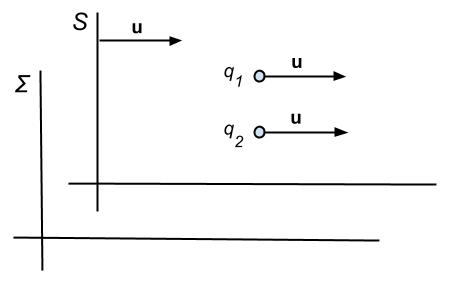
Charges moving at same speed.png

The force acting on an electric charge in the presence of another electric charge can thus in this case be explained in completely different ways using the concepts of E and B. But the application of this force constitutes a single event for which it should be possible to give a single explanation which holds in any frame of reference. It is clear that the concepts of E and B cannot furnish such an explanation.

And that's not a problem, according to Rosser's interpretation of classical electromagnetism, since E and B merely serve as convenient mathematical concepts which do not correspond to any particular physical reality.

Rosser's interpretation of classical electromagnetism is very clear and perfectly coherent, but it's also very frustrating for somebody who wants to understand just how charged particles communicate changes in their location and their states of motion to each other.

This all the more since I believe an understanding of these processes would help to shed light on the cause of relativistic length contraction - a fundamental building block in the special theory of relativity.

That is why I have started to develop my sphere model of electricity, in which local accelerations of an electric charge lead to electric disturbances which travel outwards through a series of electric spheres surrounding the charge. These disturbances modify the way in which the charge acts on other charges.

As it stands, my model may give a reasonably plausible explanation of electric length contraction (as I have argued here and here, with some provisos set out here), but it's far removed from explaining the full range of electric interactions between charges in any state of motion.

Sadly, it seems that classical electromagnetism offers me little guidance on how I might be able to expand or modify my model so that it can explain a broader range of phenomena.


Wednesday, 30 October 2013

The concept of the "electric field" (1)

In W. G. V. Rosser's Interpretation of Classical Electromagnetism, the "electric field" is first and foremost a mathematical entity which does not correspond to any particular physical reality.

The only electromagnetic concept which, for Rosser, corresponds to a distinct aspect of reality is that of "electric charge", which is seen as the cause of "forces" between charged particles, which manifest themselves in changes in the states of motion of those particles.

In Rosser's interpretation, the "electric field" is essentially a convenient mathematical tool to help work out the force that acts on a charge q at a time t on the basis of our knowledge of the positions and states of motion of a given set of charges near q over a certain period of time leading up to t.

To see all this in greater detail, let me first look at Rosser's definition of the "electric field E at a fixed point in empty space". This field, Rosser says, "is defined in terms of the force Felec acting on a stationary test charge of magnitude q placed at the field point using the relation:

E = Limit (Felec/q)

in the limit when the magnitude of the test charge q tends to zero."

Rosser explains the need to let q tend to zero by pointing out that a large charge q would lead to changes in the configurations of surrounding charges, which would in turn change the force acting on q. However, it seems to me that such changes would only occur after a certain time, so I'm not convinced the limiting condition is essential, provided empirically the ratio of the measured force to q does not depend on the size of q.

Leaving this issue aside, Rosser's definition only works if we have already defined "force". Rosser does this on page 1 of his book, where he defines the force F on a particle of rest mass mo that is moving at the velocity u as

F = d/dt (mou/(1-u2/c2)1/2)

where c is the speed of light.

This definition might appear to pose a problem if we want to derive electric length contraction and time dilation by the relativistic factor from the equations of electromagnetism, since it already includes the very relativistic factor we are supposed to derive. However, since the electric field is defined purely with reference to the force on a stationary test charge, u = 0 and Rosser's force formula reduces to the classical F = ma.

Things get more complicated when Rosser applies the concept of the electric field to moving charges. "It is assumed in classical electromagnetism", Rosser says, "that, if the charge q is moving and accelerating in an electric field, the electric force on the moving charge is still given by

Felec = qE."

Clearly, in this situation we need a concept of force that applies to moving particles, and Rosser suggests that the relativistic definition of force should be used. However, empirically, using this definition of force, the total force on a test charge q moving at u in the presence of other moving charges is in general not given by

F = qE

but by

F = qE + quxB

for a suitably defined field B.

So, is Felec = qE for a moving test charge a law, or is it rather a definition of a new concept of "electric force", which is deemed to act on a charged particle in any state of motion, as distinct from the total "electromagnetic force" that acts on that particle?

The latter is indeed how classical electromagnetism seems to proceed.

Let me summarize what is a matter of definition and what is a matter of empirical fact in the development of the concept of an electric field in Rosser's interpretation of classical electromagnetism.

1) The electric field E in a field point P at a given time t is defined as the total force on a small stationary electric test charge q in P at the time t in the presence of other charges in any state of motion, divided by q. "Force" can in this context be defined in accordance with the classical formula F = ma.

2) It is then found empirically that the force on a stationary charge q of any magnitude in the presence of other charges in any state of motion is F = qE.

3) The electric force Felec on an electric test charge q in any state of motion in the presence of other charges in any state of motion can then be defined as Felec = qE.

4) It is found empirically that, in the presence of other charges which are all stationary, the total force F on an electric test charge q in any state of motion is given by F = Felec if F is defined using the relativistic definition of force.

5) It is found empirically that, in the presence of other charges in any state of motion, the total force F on an electric test charge q in any state of motion is in general not given by F = Felec if F is defined using the relativistic definition of force.

This analysis raises questions about the physical significance of the concept of the "electric field" in classical electromagnetism. As long as we only consider electric forces on stationary charges, the significance of the concept seems fairly clear: the force on such a charge is always qE, regardless of the size of q, even though we have defined E with reference to small test charges only.

However, the picture gets much murkier once we consider effects on moving charges.

To start with, if we want to maintain the classical definition of force F = ma, it turns out that qE is not equal to that force for a moving charge q even if the surrounding charges are all stationary. This presents us with a choice.

1) We could consider that the concept of E is not useful in this situation as the law that links E to F in the stationary case does not accurately reflect the observed phenomena for a moving charge q; or

2) We maintain the law that links E and F in the stationary case by adjusting the classical concept of force so that the law applies to moving charges q, too.

Classical electromagnetism opts for the latter possibility. But there is an additional difficulty when the charges around the moving charge q are in motion, too. For then it is found empirically that in general the law that links E and F doesn't even apply if the new, relativistic concept of force is used. To make the law fit the observed phenomena, a new concept, the "magnetic field B", is introduced and incorporated into the force law, which becomes F = qE + quxB.

In light of all this, is there any sense in which E can be identified with a physical reality which can be regarded as the cause of forces on moving charges or of changes in their motion?

I will discuss Rosser's answer to this question in my next post.

Saturday, 14 September 2013

The concept of "electric charge"


Over the next few months, I would like to examine the role of concepts such as "electric charge", the "electric field" and the "magnetic field" in classical electromagnetism.
 
My aim is to understand how these concepts are used, together with experimental findings, to arrive at some of the laws of classical electromagnetism, including Maxwell's equations and the "electric length contraction" of moving bodies by the relativistic factor.
 
I have decided to base my investigations on William Geraint Vaughan Rosser's book Interpretation of Classical Electromagnetism (1997).
 
Of the three concepts mentioned, that of "charge" is perhaps the most fundamental and seemingly straightforward. It is closely tied to the notion of "particles", which are said to be carriers of "charge" if they show characteristic forms of attraction or repulsion. Rosser speaks of "charged atomic particles such as electrons and positive ions". He says that, in his book, such "classical point charges" will be treated as "continuous charge distributions of exceedingly small but finite dimensions" (p. 2).
 
The suggestion is that "charge" is a real attribute of at least some particles. These particles and the "charge" they carry are thought to occupy an "exceedingly small" amount of space.
 
A first difficulty presents itself here if we consider that the attraction or repulsion between such "point charges" is effective over distances which are very large compared to the "exceedingly small" size of the charges. If it is "charge" which is responsible for this attraction/repulsion, should we not conclude that, far from occupying a very small amount of space, "charge" is something which is spread out over all of space, although its intensity or density decreases as we move away from a charged particle's point-like centre?
 
Whatever the merits of such an approach may be, it does not seem to have been explored in the context of classical electromagnetism. So, what is it in classical electromagnetism that accounts for the action of "charge" over large distances? Is it perhaps the "electric field"? In my next post, I will begin to examine what role this concept plays in Rosser's interpretation of classical electromagnetism.